The Alignment Layer
June 01, 2026
In May 2026, several tech companies made the same structural bet within a month of each other. Coinbase capped its organization at five layers, replacing “pure managers” with player-coaches. GitLab cut three management layers and reorganized R&D into 60 smaller, more autonomous teams. Meta laid off 8,000 people and pushed responsibility down the chart. Jack Dorsey wants Block at two or three layers, down from five. ClickUp restructured around smaller pods.
The headlines read as cost-cutting, or restructuring to adapt to a changing world. The harder question: if you flatten the org, what replaces the coordination layer you removed?
What the coordination layer does
Middle management exists for a reason. The caricature version is PowerPoint, politics, and meetings about meetings. The real version is something else.
Someone has to know whether the engineering team is building the right thing this quarter. Someone has to notice when the sales pipeline is stalling and the product roadmap has not caught up. Someone has to translate “we’re losing customers in the SMB segment” into “we need to ship X before Q3.” That translation work, between business reality and execution priority, is what keeps a company pointed in the right direction.
When you flatten the org, you remove the humans who did that translation. The translation still has to happen. It has no medium.
The alignment problem at scale
Execution teams are getting small and fast. A team of three engineers with agents ships what fifteen needed before. The execution layer is more capable than it has ever been.
The bottleneck has shifted. The question is whether execution is pointed at the right things.
In a flat, fast company, that is hard. The CEO cannot personally read every Linear ticket, every support conversation, and every sales call and connect them to what the roadmap should look like next week. Engineers cannot monitor churn trends, marketing funnel conversion, and pricing experiment results while shipping features. The gap between “what is the business telling us” and “what are we building” widens as teams get smaller and faster.
Call it the alignment layer. It is the mechanism that closes that gap.
What the alignment layer looks like
The alignment layer is a product category still being built. The pieces are in place. The demand is clear.
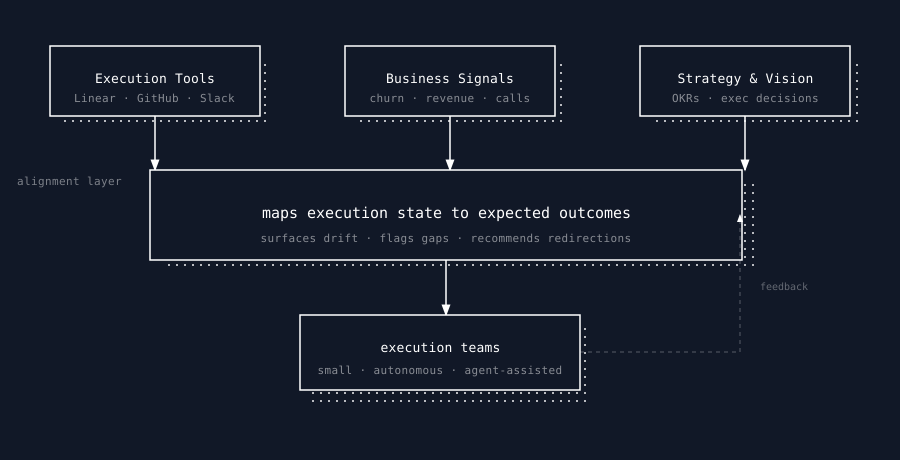
It takes in three types of input.
Operational data from execution tools. Linear, Jira, GitHub, Notion, Slack. What is the team working on right now? What shipped last week? What is blocked? What decisions were made and why? The alignment layer reads the live state of execution continuously.
Business metrics and signals. Churn rate, revenue, signups, marketing funnel conversion, support ticket volume, NPS, time-to-close. Customer calls, sales call transcripts, support conversations, email threads. The numbers tell you whether the company is healthy. The conversations tell you why. The alignment layer reads both at the frequency of a live dashboard, not a monthly board report.
Strategy and vision from leadership. OKRs, company priorities, executive calls, strategic decisions. What the company believes about where it is going and what matters most. The alignment layer consumes these as structured inputs rather than context locked in the CEO’s head.
From these three inputs, the alignment layer produces continuous, specific signals about whether execution is moving in the right direction, and where it needs to be redirected.
What redirection looks like in practice
The alignment layer notices that churn is accelerating in the SMB segment. It reads the support tickets for the past thirty days and finds a cluster around a specific onboarding flow. It checks the roadmap and sees no work scheduled on that flow for the next six weeks. It surfaces a recommendation to the relevant team lead and the product owner, with the evidence attached.
The team lead gets the recommendation with the evidence attached. The gap between “the business is telling us something” and “the team acts on it” shrinks from quarters to hours. No quarterly review needed. No deck.
What the future company looks like
Small execution teams. Fast, autonomous, agent-assisted. Capable of shipping what much larger teams produced before.
An alignment layer that reads the operational state of execution and the real-time state of the business, and continuously checks whether they match. That surfaces drift early, before a quarter is wasted. That redirects without the friction of a reorganization.
Leadership that sets strategy and vision, reviews alignment signals, and makes the calls that require human judgment. Smaller, closer to the work, faster to course-correct.
In this model, the coordinator role becomes a product.
The product gap
Tools like Port are connecting engineering context to engineering outcomes — who owns what, what shipped, what is healthy. The category is young and the tooling is raw.
The missing product is one that connects the business metrics layer, the churn, the funnel, the revenue signals, to the execution layer in real time, with enough intelligence to recommend specific redirections. Most alignment tools today are dashboards. The flat, fast company needs an active layer.
The companies that build it first will have a significant advantage over every organization trying to stay aligned through meetings.
The org chart is flattening. The alignment problem remains. It needs a new solution.